Tag: Blindness
To Audiology Associates
The kindness you showed stirred in each flawed ear
when you plugged them with hearing aids gratis that day:
Some sounds that had abandoned me I can now hear,
like the tap, tap, tapping of my blind white cane, helping me steer
to the swooshing sea brushing the shores of Chesapeake Bay—
the kindness you showed stirring in each flawed ear.
The chorus of chirps in the trees so clear
through the tinkling of angelic wind chimes helping me say
some sounds that had abandoned me I can now hear,
like the sizzles from the skillet as sausages sear
and the beeping microwave finishing up my fish fillet,
the kindness you showed stirring in each flawed ear,
a whisper that still quite often brings me good cheer
whenever a forgotten sound comes alive along the way:
those sounds that had abandoned me I can now hear.
Even as that plague of Usher Syndrome brings deafness near,
I still often thank Jesus whenever I pray
for the kindness you showed still stirring in each flawed ear,
and for the sounds that had abandoned me I can now hear.
Matt Harris
Blind and Hearing-Impaired Poet
August 7, 2024
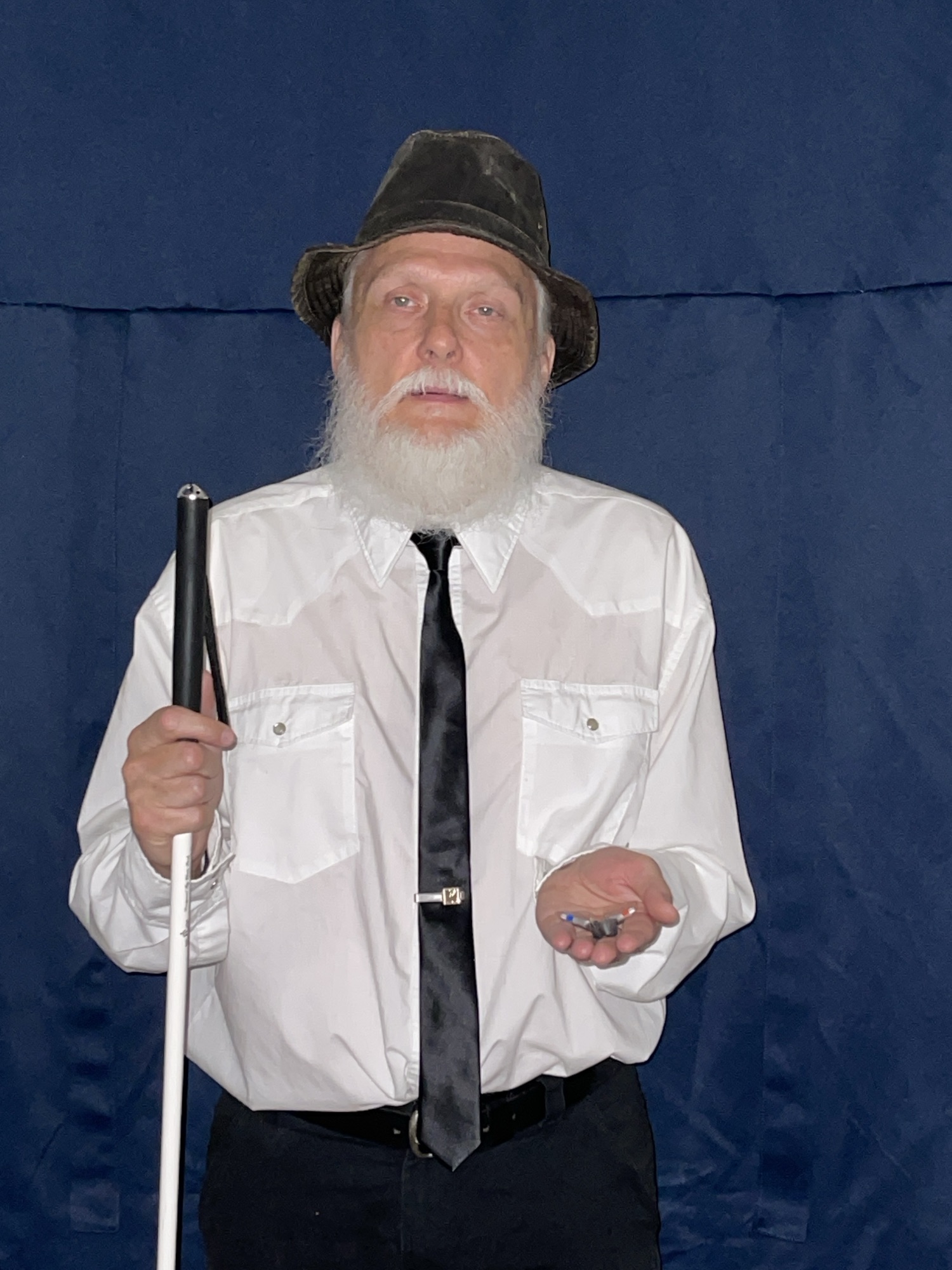
Photo taken by: Amanda Gene Harris
Back Cover Text from When the Seventh Trumpet Sounds by Matt Harris
Pictorial carousel by Amanda Harris
A Little Bit bout “The Last Thing I Ever Saw Out There”
I was struck with the idea to write my poem, “The Last Thing I Ever Saw Out There,” while listening to Molly Burke’s memoir, titled It’s Not What It Looks Like. In her book, Molly, a popular YouTuber, tells about her experience going blind from an incurable eye disease called Retinitis Pigmentosa, RP for short. You should check it out. It is very informative. I could relate to much of what Molly wrote about RP because I, too, live with the disease in my own life. Although RP has its own signature symptoms, such as tunnel vision, night blindness, and sensitivity to sunlight, no one can ever tell us when complete blindness will occur—if indeed it ever does. Some people with RP, for instance, still drive at age 60, others like Molly go blind at an early age, while others like myself go blind later in life. Nonetheless, for those with RP who still retain some sight, the prospect of going completely blind still always lurks in the shadows.
In Molly’s memoir, she answers an interesting question someone had asked her: “Do you remember the last thing you saw before you went blind?” At that point, I paused her book and began to ponder that question. I wondered if the answer to it might depend on if one went blind gradually over the course of several, or many, years or lost it instantaneously, such as in an automobile accident. That’s when the title for my poem came to me. I then hit play, finished Molly’s book; and the next day got busy writing, “The Last Thing I Ever Saw Out There.”
The Last Thing I Ever Saw Out There
pictorial carousel by Amanda Harris
Turning the Tables
A Little Bit about “Fall Risk”
As a blind poet, the things I look at every day look pretty much the same to me. But fortunately, since I did not go completely blind until later in life, I can still conjure up visual images from my memory from the things I once saw to use in my poems. But I must admit that I do indeed miss seeing that everyday poetry that exists right under our noses as we go about our daily business. For example, the title for my poem “Fall Risk” came to me immediately after my wife, Amanda, described the bracelet to me that the nursing staff at the hospital had attached to my father’s wrist, which I later describe in the poem, “where the letters in the phrase Fall Risk blaze black / against the amber face of your bracelet” (lines 12-13). At sunset that same evening, which also was the winter solstice, Amanda and I went on a walk together. During our walk, she described one of the most beautiful skies that I had ever heard, which I turned into these lines from “Fall Risk”: “Just beyond solstice’s greedy, falling shadows, / strips of yellow ribbon still wrap the sloping sky, / surrounding twilight with cotton candy clouds” (19-21). Not all imagery, however, no matter how intriguing, will work in our poems. For me, the imagery must connect with the content or themes or contribute to the movement of the piece. For instance, during our walk that night, Amanda also pointed out a pizza that someone had dropped next to our neighborhood dumpster. Initially, as a result, these lines found their way into my poem: “Its sauce like blood splattered on December asphalt.” Even though I loved that image and wanted to expand on it, after my final edit, I deleted the line. It just did not work. I would not be surprised, however, if it did not crop up in a future poem. On the other hand, I was able to use the cotton candy clouds to transition into a childhood memory about my father: “Remember cotton candy, dad? Remember? / At the circus? How I picked at its beehived hairdo” (lines 22-23)? Sadly, dad passed away on May 20, 2022, just six months after I was first inspire to write “Fall Risk.” We miss you, dad. But I know that you are with Amanda and me as we go on another winter solstice walk tonight.
 The Poet's Point