Category: Blogs
Book Signing
To Audiology Associates
The kindness you showed stirred in each flawed ear
when you plugged them with hearing aids gratis that day:
Some sounds that had abandoned me I can now hear,
like the tap, tap, tapping of my blind white cane, helping me steer
to the swooshing sea brushing the shores of Chesapeake Bay—
the kindness you showed stirring in each flawed ear.
The chorus of chirps in the trees so clear
through the tinkling of angelic wind chimes helping me say
some sounds that had abandoned me I can now hear,
like the sizzles from the skillet as sausages sear
and the beeping microwave finishing up my fish fillet,
the kindness you showed stirring in each flawed ear,
a whisper that still quite often brings me good cheer
whenever a forgotten sound comes alive along the way:
those sounds that had abandoned me I can now hear.
Even as that plague of Usher Syndrome brings deafness near,
I still often thank Jesus whenever I pray
for the kindness you showed still stirring in each flawed ear,
and for the sounds that had abandoned me I can now hear.
Matt Harris
Blind and Hearing-Impaired Poet
August 7, 2024
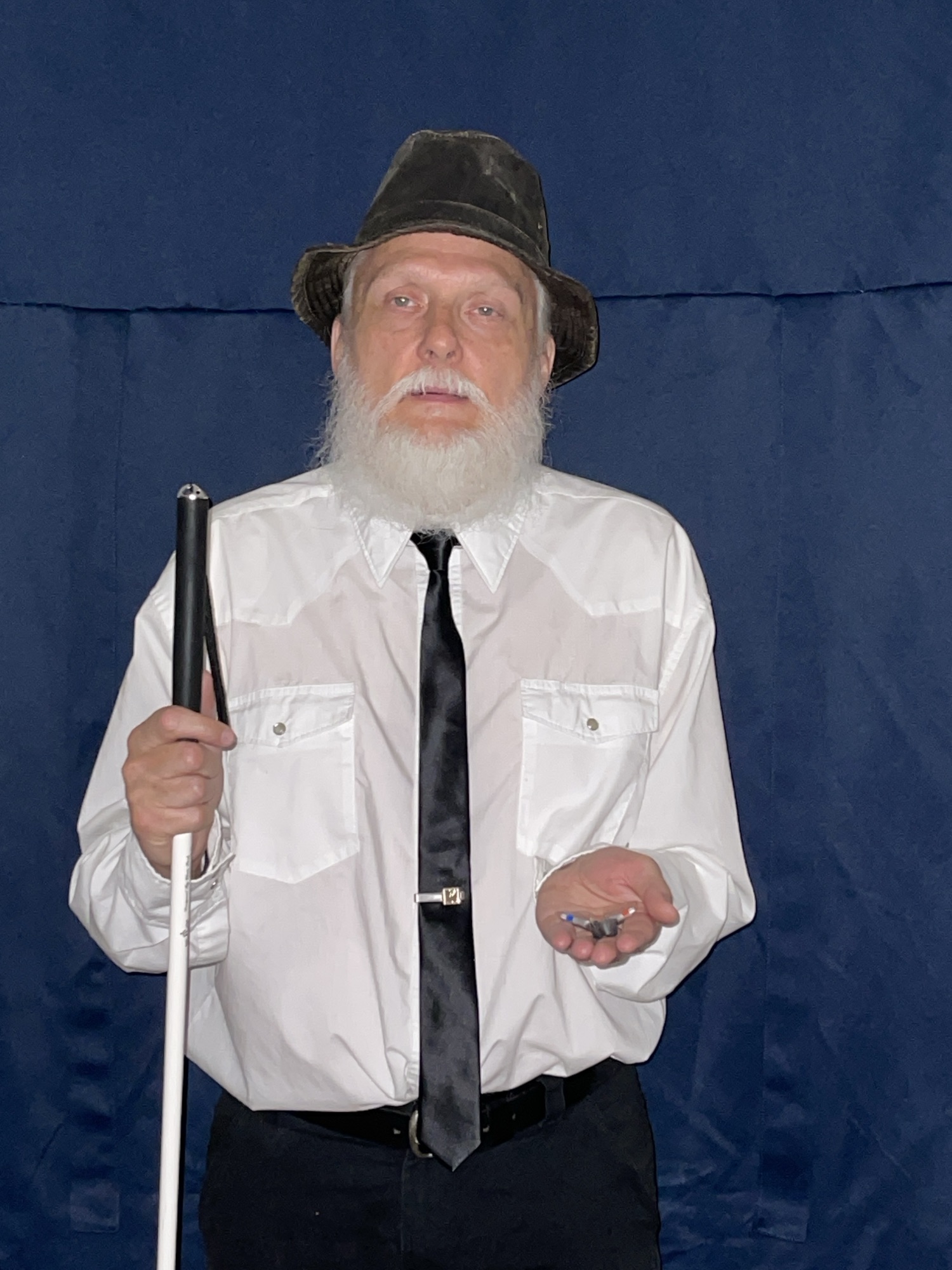
Photo taken by: Amanda Gene Harris
Book Signing on August 24
BOOK SIGNING
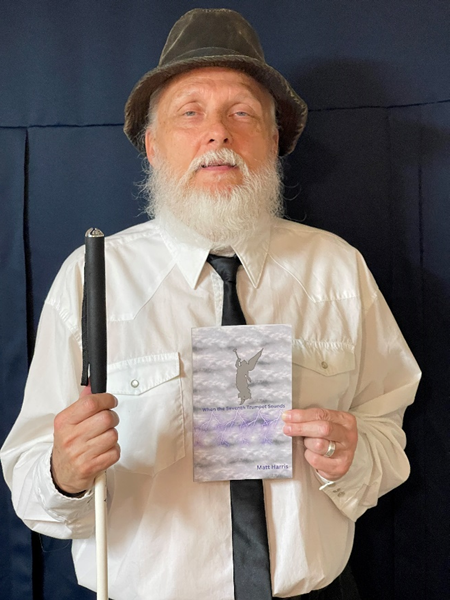
On Saturday, August 24, between Noon and 2:00 PM, His Way Christian Bookstore, located at 56 Mountain Road in Glen Burnie, MD, will be hosting a book signing for me. Copies of my latest book, When the Seventh Trumpet Sounds, will be available. All proceeds from sales will go to His Way Christian Bookstore to help keep their light shining in our community. My wife, Amanda, will also be joining me. If you are in the neighborhood, please stop by and say “hello.” We look forward to seeing you.
From Back Cover of When the Seventh Trumpet Sounds by Matt Harris
When the Seventh Trumpet Sounds is a modern day mini-epic piece that combines elements of both poetry and fiction. The poem weaves together a dystopian narrative of what society might look like in the last days on planet earth. As the story unfolds through the eyes of the poem’s speaker, who waits in a lengthy line trudging toward martyrdom at the guillotine, other colorful characters join the plot to move the action along, like for instance, the demented executioner, Mal-War, and the clueless pastor, Dr. Haywood Stubble.
Although the poem builds on end-time prophetic tropes from the past, this futuristic rendering of them takes a different pathway than many of the popular ones today based on pre-tribulation rapture theology. With that in mind, the title of this book gives a hint as to where the narrow pathway of the poem leads. When the Seventh Trumpet Sounds is a blast from the future that will help enlighten, encourage, and educate its readers to look beyond our temporal world to the eternal one—where every person in the human race now waits in a lengthy line to enter.
Crushing
Elyse’s chore always was to crush them,
a decade already spent crushing them.
The crushing started as she helped clean up
from the violence her sixth birthday party incited:
after Mr. Frank, their next door neighbor, smacked
her mom on the forehead with two drunken lips,
a little too much loving thy neighbor for her father’s taste,
who then added in great haste with just three jealous gulps
another can to the Natural Light collection—
and a decade of Kansas Correction;
and not for the first time,
his upside down horseshoe ring shattered teeth,
after a swift backhand to her mom’s freckled face;
while somehow still clutching six candles and Natural Light,
her round butt stuffed in skinny pants landed
on Elyse’s Sponge Bob Square Pants’ cake,
as a chorus of police sirens in the distance belted out
Happy Birthday to You.
And while the shrill of the tune neared,
Elyse’s dad lifted her onto the stepstool;
she wobbled a bit at first like how her dad just toddled
with her in tow bursting through
their kitchen’s swinging saloon doors.
As she lost the grip on her little stuffed black lamb,
Elyse steadied herself on the stepstool
that raised her up to face the wall-mounted can crusher,
her dad instructing her how to crush them.
“Here, now you try. Crush it!” he said,
handing her another emptied can.
The Happy Birthday tune ended,
a frozen moment then a nod from her father,
as he raised his hands as if in praise toward the ceiling,
the saloon doors slamming open—
county party crashers, Glocks drawn, then cuffed him.
She had watched her dad do it many times before that day:
crush them over and over again.
With two hands, gingerly, almost reverently,
like a priest placing the chalice in the tabernacle,
Elyse placed the can in the mouth of the crusher
and twisted it until its lettering faced her;
she knew by then what Natural Light spelled,
and would soon learn more of its bewitching spells
when Mr. Frank would become Uncle Frank,
and later when dozens of other Uncle Franks filled the ranks.
She then jerked her hands away as if not to get bitten,
like how she once jerked her hands from her Whiffle Ball
stuck between the snarling teeth of the Hound Dog;
she then placed her two tiny hands on the lever and pulled,
as if in slow motion the can began crinkling,
reminding her of the sounds when her hungry stomach growled
as it flattened like one of mom’s rare hamburger patties;
it then spat the last of its warm venom into her face,
like that warm loogie Willie Hale hocked in her face
at lunchtime in kindergarten last year.
She crushed them, later she was told, to save the environment;
she knew the truth by then, though, was to crush them, to recycle them
to earn more money to buy more of them,
hundreds of them, no, probably more like thousands,
thousands of those silver 12-ounce aluminum cans:
a backdrop for their eye-grabbing blue and red lettering
in Natural Light frozen on their refrigerated faces;
sweat glistened from them as their chilled bodies warmed
in the calloused grips many drunkards grasped them with;
curtains closed to the Light of the world that’s come,
opening instead to the beams of artificial light
that now cracked through their dawns and darkened
the lines on her mom’s and each of her Uncle Frank’s faces—
during that decade of her dad’s incarceration.
She crushed and crushed and crushed!
Over and over again she crushed them,
yet their stale remains still crowded the kitchen counter:
some stood shoulder to shoulder,
while others lied sideways corrupting
like the breathing corpses passed out on mom’s couches,
some of their midsections squished in, their mouths gaping,
gaping like her mom’s in the throes of dry heaves,
like last night, for instance,
as she bent over the back porch railing
and waited for the storm clouds inside her stomach to burst—
a patch of petunias raising umbrellas below.
Elyse then took a last deep drag from her Newport
and held her breath, while dropping
her cigarette into the mouth of the abyss;
she then listened to that familiar fizzle,
as backwash from her Natural Light extinguished it.
She then crushed its body with one bare hand
and tossed it sideways into the dented heap;
then exhaling the breath she held from her Newport,
she doused sixteen flaming years from her birthday cake;
her firstborn, little Billy, swaddled
in his carrier like a caboose on her back.
His grandmom’s Natural Light still remained unopened,
as it perspired in her swollen hand;
her swollen body stuffed inside
its extra large Metallica T-Shirt and Walmart sweats;
her yellowish gaze now fixed
on a Styrofoam cup half filled with black Folgers,
cradled in her just-paroled husband’s gaunt hand,
and that jailhouse tattoo of a cross
that now replaced the upside down horseshoe ring
that once weaponized his swift backhand.
Her yellowish gaze then like a spell got broken,
the saloon doors creaking on crooked hinges,
as Elyse reached into the night
and fumbled in the fridge for more Natural Light.
A Little Bit bout “The Last Thing I Ever Saw Out There”
I was struck with the idea to write my poem, “The Last Thing I Ever Saw Out There,” while listening to Molly Burke’s memoir, titled It’s Not What It Looks Like. In her book, Molly, a popular YouTuber, tells about her experience going blind from an incurable eye disease called Retinitis Pigmentosa, RP for short. You should check it out. It is very informative. I could relate to much of what Molly wrote about RP because I, too, live with the disease in my own life. Although RP has its own signature symptoms, such as tunnel vision, night blindness, and sensitivity to sunlight, no one can ever tell us when complete blindness will occur—if indeed it ever does. Some people with RP, for instance, still drive at age 60, others like Molly go blind at an early age, while others like myself go blind later in life. Nonetheless, for those with RP who still retain some sight, the prospect of going completely blind still always lurks in the shadows.
In Molly’s memoir, she answers an interesting question someone had asked her: “Do you remember the last thing you saw before you went blind?” At that point, I paused her book and began to ponder that question. I wondered if the answer to it might depend on if one went blind gradually over the course of several, or many, years or lost it instantaneously, such as in an automobile accident. That’s when the title for my poem came to me. I then hit play, finished Molly’s book; and the next day got busy writing, “The Last Thing I Ever Saw Out There.”
A Little Bit About “Before the Severing of the Silver Cord”
A friend of my wife recently brought our attention to an Old Testament passage of Scripture found in The Book of Ecclesiastes. It has been quite some time since I have visited these writings of King Solomon. Fans of classic rock might recall The Byrds’ hit song back in the sixties called “Turn! Turn! Turn!” Most of its words came directly from a passage from Ecclesiastes Chapter 3. The song shows how King Solomon’s words are just as relevant in modern times as they were when he wrote them back in the ninth century B. C. They don’t write songs anymore like they used to. That’s for sure.
The passage that stirred my wife’s friend’s curiosity, however, is found in Ecclesiastes chapter 12, Verse 6, which reads: “Remember your Creator before the silver cord is loosened….” She was particularly interested in the meaning of the “silver cord.” As I looked more deeply into the chapter, I began to see how some of it also seemed to tie in with end-time Biblical prophecy. That’s where the idea for my poem “Before the Severing of the Silver Cord” originated. Although the poem was not initially intended to be one about grief, the poem nevertheless took a “Turn! Turn! Turn!” in that direction. I suppose grief escaped from my subconsciousness somehow since I had been mourning the loss of my father who had recently passed away.
A Little Bit about “Turning the Tables”
I began writing “Turning the Tables” in January of 2022. My new wife, Amanda, and I had just been newlyweds for two months. The temperature dipped into the twenties that evening; and To keep warm, we decided to clean out my closets to make some room for her things in our small apartment. At that time, I had been reading Emily Fragos’ poem, “The Sadness of Clothing.” The speaker in the poem tells about going through her spouses clothing after he passed away. Even though no one had died, I still felt a sense of grief as we pored through my stuff that had accumulated over the years, deciding what to part with. “Turning the Tables” started churning when we found my old rucksack with its portable table inside that I write about in the poem. I rarely write in the second person viewpoint, but the way Fragos used it in her piece inspired me to try it in mine. I truly would not feel the impact of her opening two lines, however, until months later as we went through my father’s “sad clothing” after he passed away: “When someone dies, the clothes are so sad. They have outlived / their usefulness and cannot get warm and full”.
My Unearthing
To forgive my sin, God died in my place.
High in the heavens He sits on His throne.
My Savior, Jesus, rose to give me grace.
Before I believed, Death laughed in my face,
knowing how Hades would burn every bone;
to forgive my sin, God died in my place,
for all the worldly pleasures I used to chase:
the drugs, the dollars, the false religions I was shown.
My Savior, Jesus, rose to give me grace!
When I started seeing through blindness, I quit the race
for the drugs, the dollars, the false religions I was shown.
To forgive my sin, God died in my place.
He loves us all. We’re each His special case.
Until I found out, my heart was like stone:
my Savior, Jesus, rose to give me grace.
The Potter’s pierced hands healed this sightless vase;
my salvation now rests on Christ alone:
to forgive my sin, God died in my place;
my Savior, Jesus, rose to give me grace.
On December 12, 1982, I placed my hope for eternal salvation in the nail-pierced hands of Jesus. On that day, I came to terms with the fact that I was a sinner, for “all have sinned and fallen short of the glory of God.” And since “the wages of sin is death,” I knew there’d be Hell to pay after I died. On that day, I also learned that “the gift of God is eternal life through Jesus Christ our Lord.” That’s when I threw in with Jesus, who was God in the flesh, who loved me enough to die on the cross to forgive my sins, and whose Father then raised Him from the dead. That’s the Gospel, and that’s what saves us from Hell if we repent and believe it. I share my testimony with you today to let you know somebody cares and that there’s hope beyond the grave: “…whosoever shall call upon the name of the LORD shall be saved.” -Matt Harris
 The Poet's Point